Beyond the Research: Hermie Monterde on Building a More Inclusive Mathematical Community
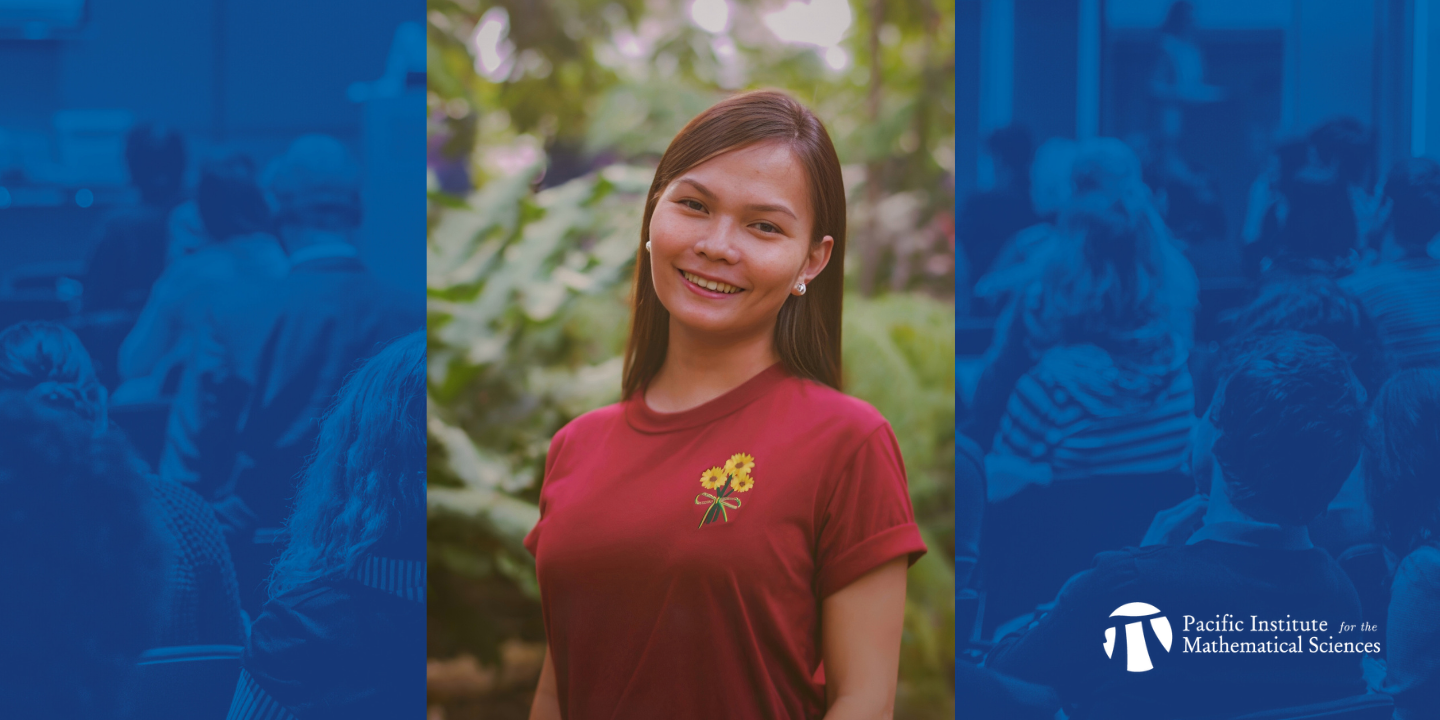
Hermie Monterde is a PIMS-Simons Postdoctoral Fellow and an NSERC Canada Postdoctoral Research Award (CPRA) recipient at the University of Regina. Her research explores quantum walks on graphs and their applications to quantum information transfer. Beyond her research, Hermie is actively involved in initiatives that foster collaboration, mentorship and greater representation in mathematics. We spoke with her recently about her academic journey and the importance of building a more inclusive mathematical community.
What first drew you to mathematics, and how did your interest develop into a career path?
I grew up in the southern part of the Philippines. I struggled with math in the early years of high school. I had to work hard to prove to myself that I could do it. I was then accepted into a bachelor's program in mathematics with a fully funded scholarship. Looking back, I did not have a choice because it was the only subject I was good at and we were financially challenged. I felt like this was the only chance for me to flee poverty. I did not have the privilege of choosing freely.
What has the transition from PhD student to postdoctoral fellow been like? How has being part of PIMS shaped this stage of your career, whether through new collaborations, opportunities or experiences?
The transition has been great. It was seamless. I finished my PhD in Winnipeg at the University of Manitoba, and it's just a six-hour drive to the University of Regina where I work now.
As a graduate student, I was a member of the PIMS EDI Committee. That experience was an eye-opener for me, and I have been active in PIMS ever since. For example, the institute supports the 05C50 Online Seminar and many great initiatives across Western Canada. I think PIMS recognizes the work that needs to be done in the mathematical community. I've been fortunate to have the institute's support throughout this journey.
Your research bridges combinatorics, linear algebra, and quantum information. What question are you currently exploring, and why does it interest you?
My research focuses on quantum walks on graphs to understand how quantum information can be transferred across a network. Quantum computers bring the promise of revolutionizing scientific computation. If we want to reliably transfer information from one area of a quantum computer to the other, it is necessary to understand how one can send information from one part of a quantum computer to another.
The most interesting part for me is that the problem is physical rather than mathematical, yet there is so much mathematics involved in understanding quantum walks. I've been collaborating with experts in those areas and together we have been unraveling wonderful results.
You've brought mathematicians together through initiatives such as your Quantum Walks interest group and the 05C50 Online Seminar, while also advocating for greater representation in mathematics. What motivates you, and what changes would you like to see in the mathematical community?
My experiences of exclusion and discrimination have shaped my perspective and motivations. Not everyone has the strength and the resolve to change things. If I can change other people's lives, one initiative at a time, I will do it.
Another reason was the limited representation I saw in math conferences that are supposed to be ‘international’ in scope. Most speakers tend to come from either Europe or North America. Together with my PhD supervisor Dr. Steve Kirkland, we organized the 05C50 Online Seminar to provide a platform to talented mathematicians who are unable to participate in international conferences. Now we have 850 subscribers around the world.
Despite these successes, I would say that many of the EDI initiatives I have organized are sometimes misunderstood. People might ask, for example, why we would hold a summer school for women and gender-diverse undergraduate students? The demographics of mathematics departments across Canada show that there is still work to be done to improve representation for the faculty members and graduate students. We need to keep working towards a more inclusive mathematical community.
Can you tell us about a collaboration that began unexpectedly?
A lot of my collaborations started with people reaching out to me. When I was a PhD student, Dr. Hiranmoy Pal, an assistant professor from India, contacted me asking questions about my work. We kept emailing back and forth until we had so many exchanges that we eventually formed a paper out of them. So far, we have written five papers together.
I also led a research group of graduate students across Western Canada through the PIMS First Year Interest Groups (FYIG). We have just published a preprint, and we are currently working on another one. I've become a horizontal mentor to them. It's a very meaningful kind of collaboration and mentorship.
What are your aspirations for the future, and what advice would you give to someone considering mathematics?
For myself, I would like to get an academic position. I would also like to continue with my EDI advocacy, because I feel like we are losing so much talent in academia as a result of exclusion.
If someone is wondering whether mathematics is for them, I would ask them, “Do you enjoy it? Do you have the determination to do the math?” These seemingly simple questions could reveal a lot. And if the answer is affirmative, then I say, “Go for it, and make sure you find your people who can help and support you along the way!”